

The Role of NAD in Aging
Research on aging has identified NAD (nicotinamide adenine dinucleotide) as an important molecule involved in cellular processes associated with aging. NAD, is a coenzyme found naturally in the cells of the body and plays a central role in many of the biological processes associated with aging, including cellular energy production, oxidative balance, and communication between cells. Healthy NAD levels help support normal cell function, metabolic efficiency, and resilience to stress—factors that directly influence how our bodies feel and function over time.
For much of human history, aging was viewed as an inevitable process—something that simply happened, with little influence over how quickly or how well we aged. Aging is recognized as a major risk factor for many chronic conditions. Research continues to explore the biological processes involved in aging and overall cellular function.
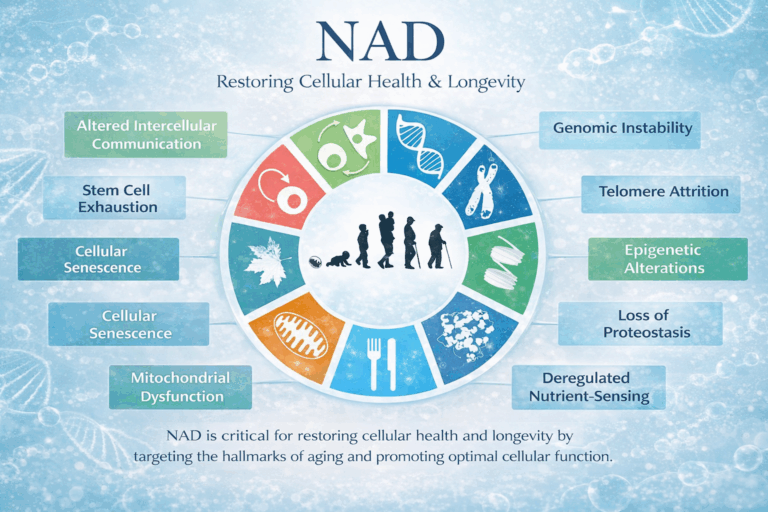
Modern research now shows that aging is driven by specific biological processes that gradually reduce the function of our cells, tissues, and organs over time. Scientists have identified a set of shared patterns behind this decline, commonly referred to as the hallmarks of aging. These changes affect how cells produce energy, repair damage, communicate with one another, and respond to stress.
Importantly, aging is no longer viewed as a fixed or purely passive process. Growing evidence suggests that the rate and quality of aging can be influenced by internal and external factors such as inflammation, metabolic health, environmental stressors, and cellular energy availability. NAD levels are being studied for their role in many of the hallmarks of aging.
NAD Depletion in The Body
Research has identified several reasons for NAD depletion:
Age: NAD levels naturally decline with age. Research shows levels begin dropping as early as our 20’s, with notable decreases in middle age and continue as we age. This is where we see lower energy production and cellular repair.
Excessive DNA damage (from free radicals): Overtime free radicals can cause damage to our DNA. This process can be aggravated by environmental toxins like:
- heavy metals
- pesticides/solvents
- Mycotoxins
- air pollution (PM 2.5)
NAD levels become depleted when the body has to constantly repair this damage.
Chronic immune activation and inflammatory cytokine production: Ongoing immune activation and chronic inflammatory states demand a lot of the body’s resources and can result in lower levels of NAD. Common contributors may include:
• Chronic inflammatory states
• Ongoing immune activation
• Prolonged stress
• Sleep disruption
How to Increase NAD Levels
NAD levels are being studied for their role in cellular processes related to aging, oxidative stress, and mitochondrial function. NAD levels are integral to cell function and are considered a key molecule linked to many of the hallmarks of aging, which are positively influenced by higher levels of NAD availability.
Because NAD levels naturally decline with age and ongoing stressors, many people are now exploring ways to support and restore healthy NAD availability as a part of a proactive wellness strategy and to maximize cellular function.
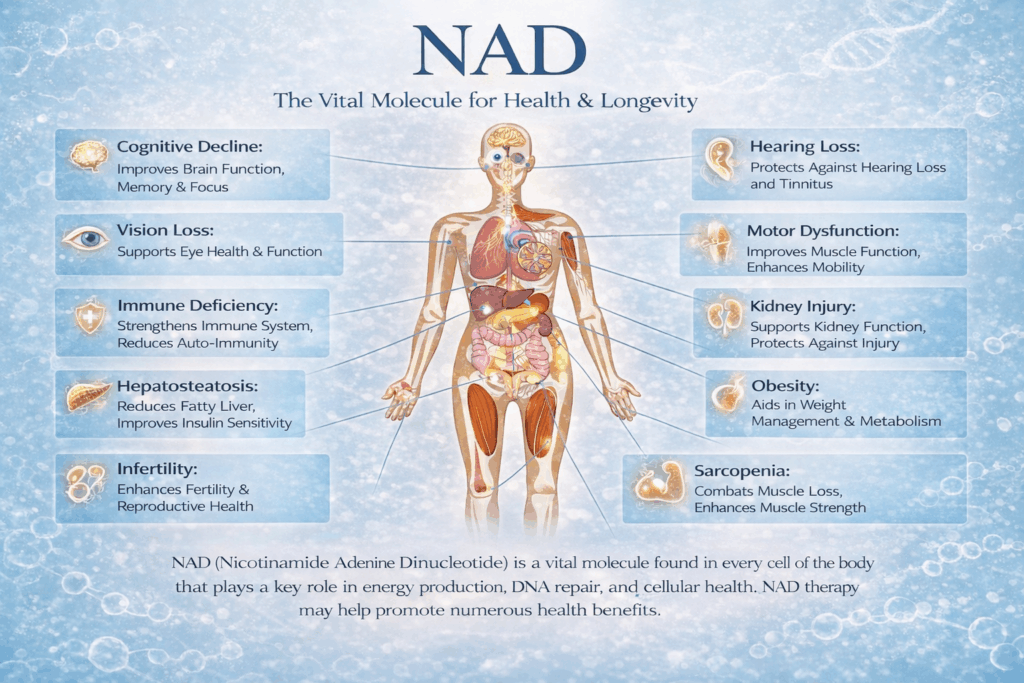
Benefits of NAD Therapy and Supplementation:
What is The Best Way to Take NAD?
NAD supplementation can come in various forms, and the best option depends on individual goals and preferences. Oral supplements may have lower bioavailability, while injections, infusions, nasal delivery, and topical applications bypass the digestive system to reach the bloodstream.
IV administration is one available delivery method and may be considered based on individual needs and clinical judgment. It allows for direct delivery into the bloodstream and may be used when a provider determines it is appropriate. Treatment frequency and approach vary depending on individual goals and response.
Subcutaneous (Sub-Q) NAD Injections
These may be administered in-office by a licensed provider or, when appropriate, provided with clinician guidance for at-home use. It is performed with a small injection just under the skin. This method is sometimes used alongside IV therapy or as a standalone option, depending on individual needs.
NAD Nasal Spray
This delivery method uses the nasal passages to bypass the digestive system. The nasal tissues have a rich blood supply and thin membrane, which may allow for absorption. Intranasal delivery can be used alongside Sub-Q or IV options, and may be a convenient alternative for those looking to avoid needles.
NAD Cream
NAD cream is applied topically, and while some absorption may occur, it is primarily used as a localized option. It may be used in certain cases based on individual needs and provider guidance.
As a topical formulation, it can be incorporated into a skincare or wellness routine. NAD has been studied for its role in cellular processes involved in skin function, though individual experiences may vary.
Safety and Considerations
Research assessing tolerance of NAD supplementation suggests it is well-tolerated by most individuals, including those with other health conditions. NAD therapy can be a helpful wellness tool, but like any therapy, it works best when it’s personalized, properly administered, and part of a broader health strategy.
Most side effects from NAD come from the particular delivery method and are short-lived. IV Therapy can cause some chest tightness and digestive discomfort when done too fast. Sub Q can cause mild irritation at the delivery site, and nasal administration can cause some irritation for some people.
Please book a 15 minute free consult to discuss which option might be best for you
Trustindex verifies that the original source of the review is Google. This place is a rare find in Asheville. They offer regenerative treatments that are of newest medical technology. Impressive!!!! (I used to fly to the west coast for the same treatments ) I signed up for the Ozone/UV therapy and the Texil Facial. Being a cyclist, I expose my skin to sun. I have had laser treatments done on my face in the past and this Texil Facial that Dr. Dula offers supersedes them all. Texil is so much more affordable as well. It has been 9 days since my Texil Facial and my skin looks SPECTACULAR!!! I am so HAPPY!!Posted onTrustindex verifies that the original source of the review is Google. I've had food poisoning before went to ER. Waited 10 hours for a bag of fluids and was sent home. This time I visited Dr. Dula. Everyone there was so kind and understanding. I felt so much better afterwards. It's my understanding they offer an array of services. I plan on doing another consultation because of the way they treated me in my time of need.Posted onTrustindex verifies that the original source of the review is Google. An amazing experience. Dr dula and staff are a wealth of information. My wife has fibromyalgia and the drips have improved her health dramaticallyPosted onTrustindex verifies that the original source of the review is Google. Such a relaxing place to be on my first visit here for various drip therapies. I look forward to feeling better and finally sleeping tonight as I came today for pain management due to fibromyalgia. Great and wonderful team!Posted onTrustindex verifies that the original source of the review is Google. Dr. Dula and her staff are amazing. Always a very refreshing visit. The team is attentive and insightful when assisting my choice of services Highly recommend!!Posted onTrustindex verifies that the original source of the review is Google. Dr. Dula and her staff are caring, compassionate, and very attentive. I had an excellent session- very relaxing!! Looking forward to returning soon.Posted onTrustindex verifies that the original source of the review is Google. If you have joint pain and are tired of it look into pro lo therapy. I have had it for different issues and it worked great. Dr Dula and staff are wonderful people.Posted onTrustindex verifies that the original source of the review is Google. Staff very friendly and professional. Facility extremely clean and pleasant. First IV today went very smoothly. Highly recommend their services.Posted onTrustindex verifies that the original source of the review is Google. The services and options available are really the best we've found in the area. Dr Dula also has the best team. Kim is always so welcoming and you can tell she works diligently to provide guest the best experience in an efficient manner. Laurel has done a few of our drips and supplement pushes and she is very gentle and definitely puts you at ease. Would highly recommend to anyone looking to make lifestyle and health changes or improvements.Posted onTrustindex verifies that the original source of the review is Google. A great place to go for IVs. I always feel better than I did when I went in. I'm going to try the prolotherapy that Dr. Dula offers as well.Verified by TrustindexTrustindex verified badge is the Universal Symbol of Trust. Only the greatest companies can get the verified badge who has a review score above 4.5, based on customer reviews over the past 12 months. Read more
References and Research:

Rajman L, Chwalek K, Sinclair DA. Therapeutic Potential of NAD-Boosting Molecules: The In Vivo Evidence. Cell Metab. 2018 Mar 6;27(3):529-547. doi: 10.1016/j.cmet.2018.02.011. PMID: 29514064; PMCID: PMC6342515. https://pmc.ncbi.nlm.nih.gov/articles/PMC6342515/#S20

López-Otín C, Blasco MA, Partridge L, Serrano M, Kroemer G. The hallmarks of aging. Cell. 2013;153(6):1194-217. https://pmc.ncbi.nlm.nih.gov/articles/PMC3836174/

Braidy N, Berg J, Clement J, Khorshidi F, Poljak A, Jayasena T, Grant R, Sachdev P. Role of Nicotinamide Adenine Dinucleotide and Related Precursors as Therapeutic Targets for Age-Related Degenerative Diseases: Rationale, Biochemistry, Pharmacokinetics, and Outcomes. Antioxid Redox Signal. 2019 Jan 10;30(2):251-294. doi: 10.1089/ars.2017.7269. Epub 2018 May 11. PMID: 29634344; PMCID: PMC6277084. https://pubmed.ncbi.nlm.nih.gov/29634344/

Conlon NJ. The Role of NAD+ in Regenerative Medicine. Plast Reconstr Surg. 2022 Oct 1;150(4 Suppl ):41S-48S. doi: 10.1097/PRS.0000000000009673. Epub 2021 Sep 28. PMID: 36170435; PMCID: PMC9512238. https://pmc.ncbi.nlm.nih.gov/articles/PMC9512238/

Braidy N, Liu Y. NAD+ therapy in age-related degenerative disorders: A benefit/risk analysis. Exp Gerontol. 2020 Apr;132:110831. doi: 10.1016/j.exger.2020.110831. Epub 2020 Jan 7. PMID: 31917996. Sharma R, Ramanathan A. The aging metabolome-biomarkers to hub metabolites. Proteomics. 2020;20:e1800407. https://analyticalsciencejournals.onlinelibrary.wiley.com/doi/full/10.1002/pmic.201800407

Sharma R, Ramanathan A. The aging metabolome-biomarkers to hub metabolites. Proteomics. 2020;20:e1800407. https://analyticalsciencejournals.onlinelibrary.wiley.com/doi/full/10.1002/pmic.201800407Izabelle de Mello Gindri, Gustavo Ferrari, Luiz Paulo S. Pinto, Juliana Bicca, Isis Kelly dos Santos, Darlan Dallacosta, and Carlos Rodrigo de Mello Roesler. Evaluation of safety and effectiveness of NAD in different clinical conditions: a systematic review American Journal of Physiology-Endocrinology and Metabolism 2024 326:4, E417-E427 https://journals.physiology.org/doi/full/10.1152/ajpendo.00242.2023

McReynolds MR, Chellappa K, Baur JA. Age-related NAD+ decline. Exp Gerontol. 2020 Jun;134:110888. doi: 10.1016/j.exger.2020.110888. Epub 2020 Feb 22. PMID: 32097708; PMCID: PMC7442590. https://pmc.ncbi.nlm.nih.gov/articles/PMC7442590/

Izabelle de Mello Gindri, Gustavo Ferrari, Luiz Paulo S. Pinto, Juliana Bicca, Isis Kelly dos Santos, Darlan Dallacosta, and Carlos Rodrigo de Mello Roesler, Evaluation of safety and effectiveness of NAD in different clinical conditions: a systematic review. American Journal of Physiology-Endocrinology and Metabolism 2024 326:4, E417-E42 https://journals.physiology.org/doi/full/10.1152/ajpendo.00242.2023

Zhiyuan Gong, Yangxi Cheng, Rui Deng, Ying Zhou, Dan Yu, Cheng Chen, Yingjie Wang, Huiyong Zhu,A crucial role of KLF2-regulated mitochondrial oxidative phosphorylation in maintaining the stemness of mesenchymal stem cells derived from bone marrow, Cell & Bioscience, (2025). https://doi.org/10.1186/s13578-025-01501-y https://www.ahajournals.org/doi/10.1161/CIRCULATIONAHA.121.056589
Ready to get treatment? Contact us to book an appointment today!
IV therapies can be booked and administered same day, while more intensive treatments require a pre-screening consult with Dr. Dula to determine the best course of treatment for your body’s specific needs.
Not sure what to do next? Give us a call at 828-237-1511, or email us at wellness@invigorateasheville.com and we’ll get you taken care of!